Care note 008 · Winter environment
Measure humidity before you mist.
A seven-day audit separates a dry plant shelf from a dry whole room—and keeps a plant-care fix from becoming window condensation or a mold problem.
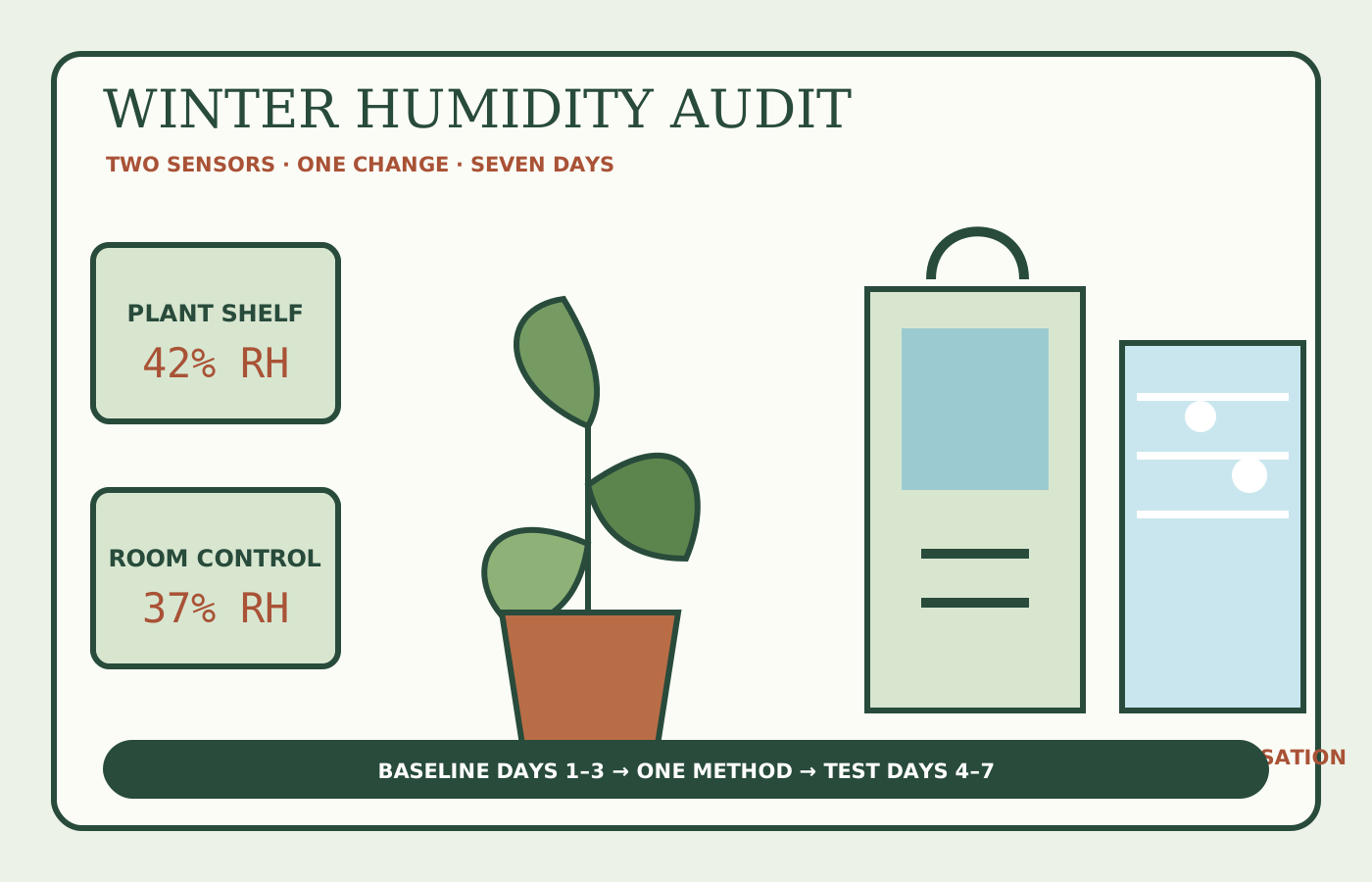
“My plant needs humidity” is often a conclusion made from one brown leaf tip. In winter, heated air can be dry—but that same tip can also follow irregular watering, accumulated fertilizer salts, water chemistry, a cold window, a hot vent, root stress, or ordinary leaf age.
The useful first move is not a spray bottle. It is a repeatable measurement at leaf level, paired with a room reading and a short record of heat cycles, watering, light, and symptoms. Public houseplant discussions in 2026 repeatedly ask whether pebble trays change anything, where to place a humidifier, and when condensation means the fix has gone too far. This guide turns those questions into a bounded test.
Plant preferences do not override building moisture limits or household health needs. EPA advises using humidifiers only when conditions require them, not exceeding 50% indoor relative humidity, reducing output when condensation appears, and keeping nearby surfaces dry. Anyone with respiratory concerns should follow medical guidance for the household.
Use two hygrometers—or move one on a schedule
Relative humidity changes with temperature, room volume, ventilation, cooking, showers, outdoor weather, and the heating cycle. One reading directly in a mist plume is not the climate a leaf experiences all day.
- Choose the plant group. Record species or cultivar when known, current care source, shelf location, window direction, heat vent, fan, exterior door, and any enclosure.
- Place the plant sensor at leaf level. Keep it out of direct sun, off wet potting mix, away from the humidifier outlet, and clear of leaves that touch the sensor. Note the exact position.
- Place the room sensor away from the group. Use the same height and avoid kitchens, bathrooms, vents, radiators, windows, and exterior doors unless one is the subject of the test.
- Compare the sensors side by side first. Leave them together long enough to stabilize. Record the difference rather than pretending inexpensive instruments are identical.
- Log morning, heating-cycle, and evening readings. Use the same times for three baseline days. Record room temperature because relative humidity changes as air warms or cools.
- Watch the building. Check windows, walls, frames, curtains, shelves and the floor for condensation or dampness. Stop adding moisture when surfaces become wet.
Iowa State Extension reports that many houseplants prefer roughly 40–50% relative humidity and that winter homes may be much lower. That is useful context, not a universal setpoint: species differ, instruments vary, and EPA's household moisture guidance sets the upper boundary for humidifier use.
Do not diagnose humidity from the leaf edge alone
Iowa State's houseplant diagnostic guidance lists low humidity as one common cause of brown tips, then names several look-alikes: inconsistent watering, fertilizer-salt buildup, water quality, temperature fluctuations, and cold damage. Add root condition, pests, disease, light change, and normal aging to the inspection.
| Observation | Other causes to check | Useful record |
|---|---|---|
| Brown tips or edges | Drying too long, salts, water quality, cold or heat | Watering dates, runoff, fertilizer label, vent/window distance |
| Leaf curl | Water stress, pests, heat, intense light, root stress | Pot moisture profile, undersides, temperature and light change |
| Bud drop | Low light, temperature shift, water stress, relocation | Move date, day/night temperature and light duration |
| Slow growth | Season, low light, roots, temperature, nutrition | New-leaf dates, measured light schedule, root and label check |
| Spots or soft tissue | Leaf wetness, disease, cold injury, overwatering | Pattern, spread, misting, airflow and watering history |
If a symptom is spreading rapidly, has halos, webbing, scale, sticky residue, visible pests, odor, soft stems, or collapsing roots, isolate the plant and seek a local Extension or qualified plant professional. A humidifier is not a pest or disease treatment.
Test one humidity method for four days
After three baseline days, choose one intervention and keep the sensor positions fixed. Do not group plants, add a tray, move the shelf, and start a humidifier on the same day; you will not know which change mattered.
Group compatible plants
Transpiration and moist media can raise local humidity. Keep space for inspection and airflow, and quarantine pests rather than hiding them in a cluster.
Use a pebble tray
Keep the pot base above the water line. Measure at leaf level and compare with the room. Empty and clean standing water routinely.
Use an enclosure
A terrarium can hold moisture for small compatible plants. Track heat, condensation, airflow and disease rather than sealing an unknown problem inside.
Use a room humidifier
This is the most reliable room-scale option cited by Iowa State. Size, placement, cleaning and output control matter; direct fog on foliage is not the goal.
Why misting is not the humidity plan
Iowa State states that misting raises humidity for only a few minutes and may help spread certain diseases. Water droplets on a leaf are not the same as sustained relative humidity. Use a shower or wipe only when appropriate for cleaning a specific plant, then let foliage dry; do not turn routine wet leaves into a climate strategy.
Pebble trays are more nuanced. Extension sources describe them as a way to add local evaporative moisture, while hobbyist measurements often find little detectable change in an open room. Both can be true because tray area, airflow, heat, room size and sensor distance differ. The audit settles the question for the actual shelf without making an unsupported universal claim.
Run a humidifier as measured equipment
Read the complete manufacturer manual. EPA notes that ultrasonic and impeller units can disperse microorganisms and minerals from their tanks; cleaning and correct water use are essential. Do not add fragrance or essential oil unless the appliance is specifically designed and documented for it, and never assume something safe for a diffuser is safe for a plant or household.
- Set the unit on a water-resistant, stable surface where it cannot tip or wet cords, furniture, walls, curtains, carpet or plants.
- Keep the output away from leaves and the hygrometer so the reading reflects mixed room air, not a plume.
- Use the maker's water, cleaning, filter and descaling instructions. Empty and dry the unit on its required schedule.
- Do not exceed 50% indoor RH with humidifier use, per EPA. Lower output or stop if windows, walls or objects collect moisture.
- Check behind the plant shelf and curtains, not just the visible window face.
- Keep electricity and water separated; retire cracked tanks, damaged cords, leaking bases and overheated plugs.
A plant shelf beside a cold exterior window may condense moisture even when the middle of the room seems moderate. The coldest surface can be the practical limit. Move the moisture source, increase safe air mixing, or choose plants that fit the room instead of forcing a greenhouse climate into a vulnerable corner.
Seven-day winter humidity log
Print this page or copy the fields into a plant notebook. Days 1–3 are baseline. Days 4–7 use one intervention. If condensation or dampness appears, stop the trial and record why.
Plant-shelf humidity audit
Plant/group: __________________ Location: __________
- Sensor comparison difference: ___________________
- Day 1 AM / heat / PM: ______ / ______ / ______ RH
- Day 2 AM / heat / PM: ______ / ______ / ______ RH
- Day 3 AM / heat / PM: ______ / ______ / ______ RH
- One method tested: ______________________________
- Day 4 AM / heat / PM: ______ / ______ / ______ RH
- Day 5 AM / heat / PM: ______ / ______ / ______ RH
- Day 6 AM / heat / PM: ______ / ______ / ______ RH
- Day 7 AM / heat / PM: ______ / ______ / ______ RH
- Temperature range: ______ Condensation: ☐ yes ☐ no
- Leaf/soil/building response: _____________________
- Keep, revise, or stop: ___________________________
Keep watering decisions separate. Higher humidity can slow potting-mix drying, but the calendar still does not decide when to water. Use the winter watering check and re-measure the root zone.
A useful equipment comparison
For a hygrometer, compare stated accuracy and range, response time, display readability, minimum/maximum memory, calibration or offset support, battery type, and whether remote logging is truly needed. Compare two units side by side before trusting a one-percent difference.
For a humidifier, document room volume, output control, humidistat range, tank access, cleanable surfaces, filter or cartridge schedule, manufacturer water guidance, automatic shutoff, cord condition, and replacement support. A giant tank is not a benefit if the shape cannot be cleaned.
Green Leaf Depot does not show prices, inventory, availability, branded listings, reseller claims, or checkout because supplier authorization and current commercial terms have not been established. Use these fields to compare documented fit rather than promotional mist output.
Connect the winter care record
Pair the humidity log with the measured grow-light setup, because light and temperature change water use. If tips appear with slow drying or gnats, use the fungus gnat control plan. Before feeding a stressed plant, run the winter fertilizer decision; salts can imitate a humidity problem.
Sources
Reviewed November 15, 2026. Species-specific care and equipment instructions remain controlling.
- Iowa State University Extension — Raising Relative Humidity for Houseplants
- Iowa State University Extension — How to Care for Houseplants
- Iowa State University Extension — Diagnosing Environmental Houseplant Problems
- University of Minnesota Extension — Winter Houseplant Tips
- U.S. EPA — Use and Care of Home Humidifiers
- U.S. EPA — Care for Your Air